We shipped one tool for Amway
then stayed for five more.

Amway is a global direct-sales business with sixty years of operations across nearly a hundred markets. We led design across a custom recommendation engine, four internal applications, and the design system that connected all of them.

RoleDesign Lead & Manager · KIS Solutions
Team3 designers — myself + 2 reports
IndustryConsumer goods · direct sales
RegionGlobal
Duration~18 months · 6 products shipped
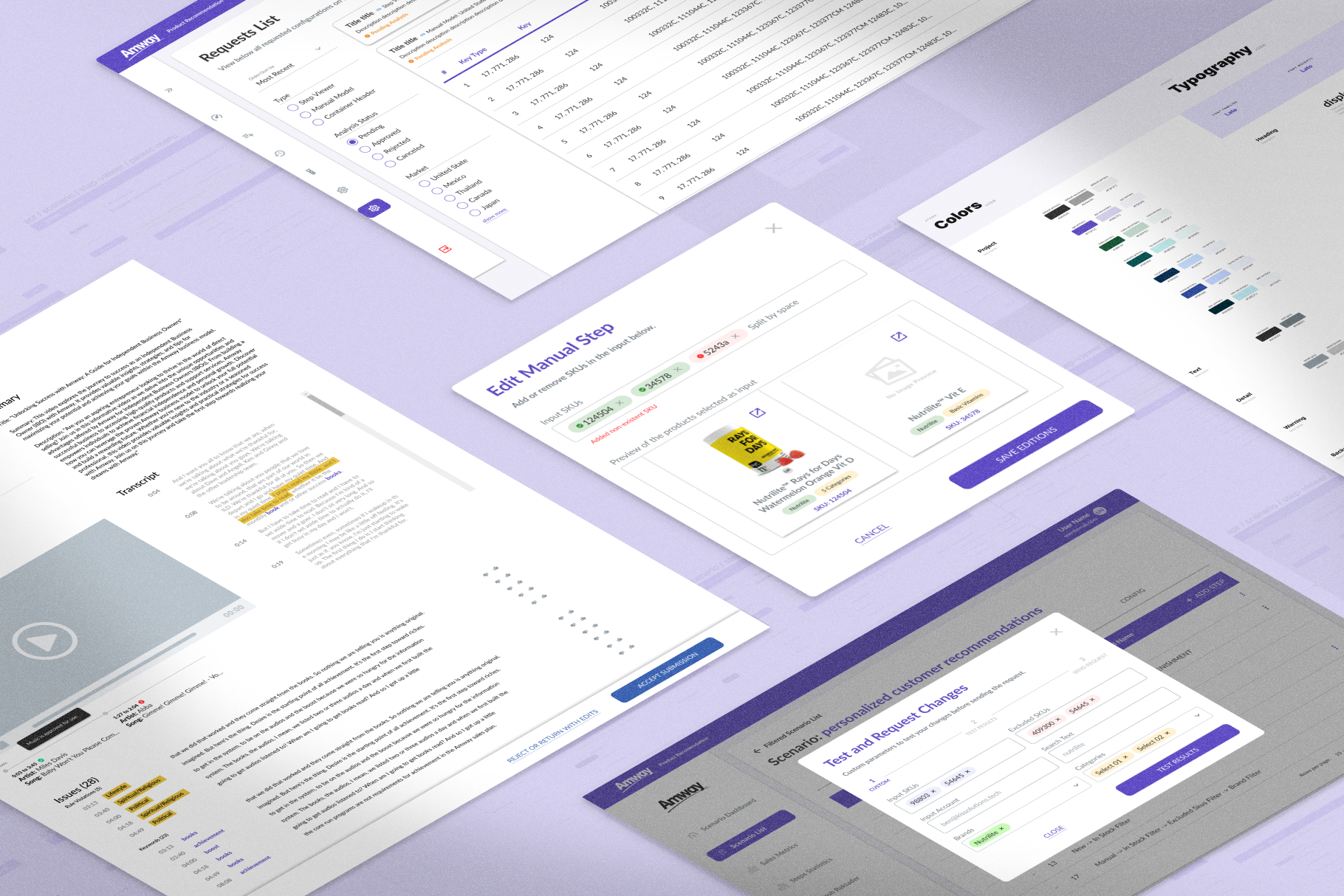
The Amway product suite — six tools rendered as an isometric stack with shared visual language.
The suite, up front. Six products, one shared design language. Built one at a time, scaled by a system the team adopted as the source of truth.

Three big
takeaways

  1. 01

    We shipped the Amway Product Recommender in three months — forty-plus recommendation models, deployed to first market, replacing a licensed enterprise tool.

  2. 02

    We built the design system that let six products ship from one shared library. Engineers adopted it as the source of truth.

  3. 03

    36% of website visitors clicked recommended products. 24% of all items sold came through recommendations. Compliance review went from days to under an hour.

01. Three months to first market

Useful, usable, and three months to first market.

Amway is a global direct-sales business with sixty years of operations across nearly a hundred markets. By the time KIS Solutions was hired, the company had a tangle of internal tools — content compliance, product catalogs, recommendation engines — built across years, none of them speaking the same language. The brief that opened the engagement was modest: build a Product Recommender that could outperform the enterprise software they were licensing.

I came in as Design Lead and Manager. Two designers reported to me; I worked hands-on across product strategy, UX, and DesignOps. The job for the first three months was a single product: the Amway Product Recommender (APR). The APR was a Recommendation Configuration Software — an internal tool the merchandising and data teams used to tune recommendation models for specific user profiles. Configurable, fast, capable of handling forty-plus recommendation models, and built to survive peak commerce traffic on the customer-facing site that consumed its outputs.
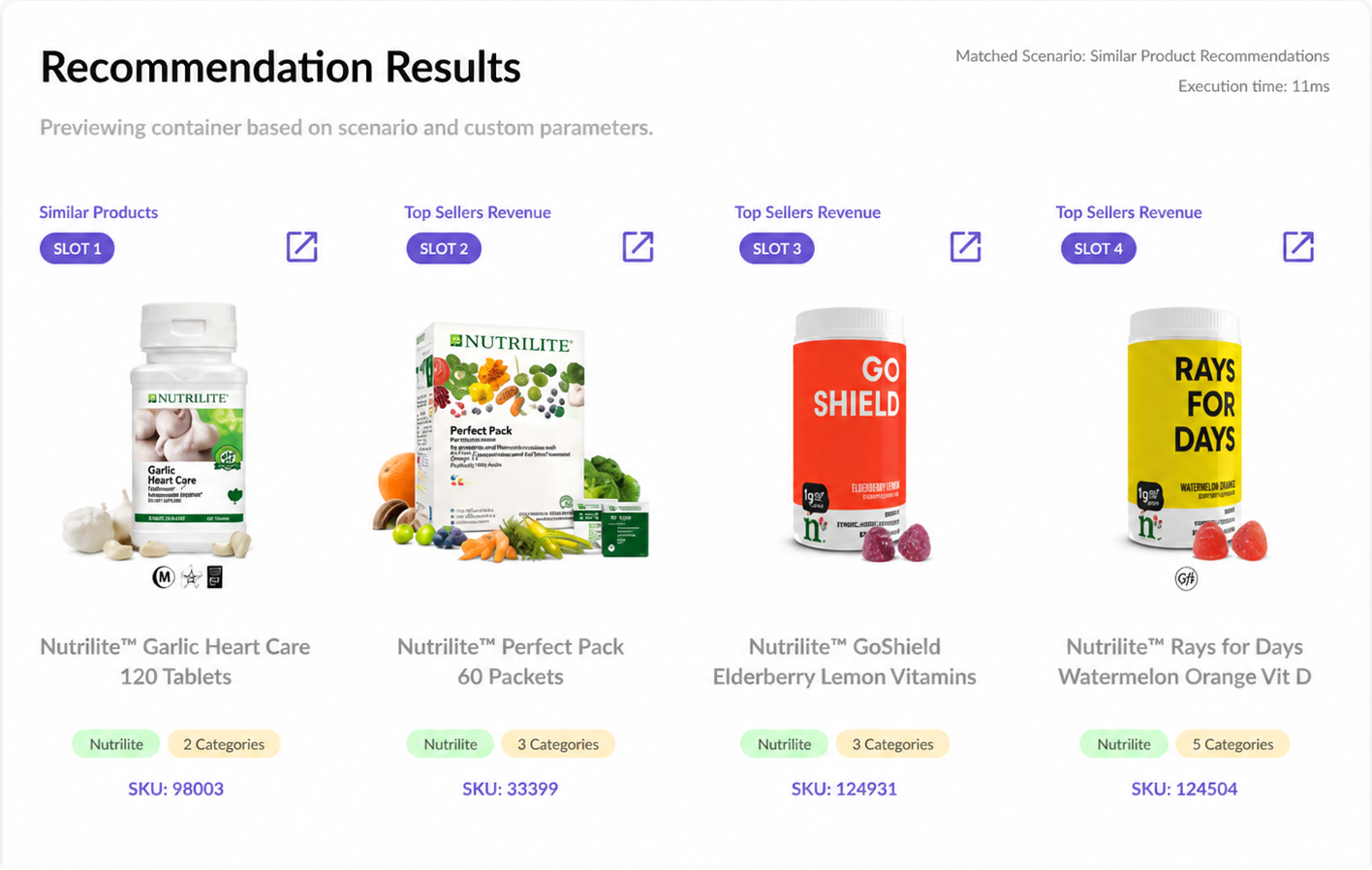
The Amway Product Recommender — internal recommendation-configuration software, used by merchandising teams to tune 40+ models for user profiles.

We shipped APR to its first market in three months. It saved millions in commercial licensing fees, outperformed the enterprise software in speed and conversion, and drove twenty-four percent of all items sold on the Amway platform — the kind of measurable outcome that earns a longer engagement. Within months, the client expanded the scope. The complementary tools came next: a manual model configuration engine for hand-tuning recommendation parameters; a merchandising rules manager for visibility and category overrides; a Product Information Management system; a Data Catalogue with big-data query and visualization; a Content Compliance Reviewer. Six tools that, together, were the operating environment merchandisers and data teams used every day.
02. The first product earned us five more

The first product earned us five more.

As scope expanded across products three, four, and five, consistency and scalability became the bottleneck. We considered building each new product against its own component set — that's how each of the inherited Amway tools had been built, and each had paid the price in documentation debt and design drift. We picked the slower path. Without a shared system, every fix would have been local; every regression inevitable. The library was the contract that earned the right to scale design output.

“A design system isn’t a Figma library. It’s a contract between teams who don’t talk every day.”

I led development of a comprehensive system: a component library with token-driven theming, a style guide, and a fully tokenized variable structure in Figma using Tokens Studio. The engineering team adopted the library as the source of truth for new feature work — they could build functional prototypes against it with minimal design oversight.

By the end of the engagement, six products were running on it.

  • Product Recommender Manager — the APR. Recommendation Configuration Software, used to tune models for user profiles.
  • Manual Model Configuration Engine — hand-tuning of recommendation models, parameters, and fall-back behaviors.
  • Merchandising Rules Configuration Manager — product visibility, position priorities, category overrides; configurable without engineering involvement.
  • Product Information Management (PIM) — system of record for global product data across nearly a hundred markets.
  • Data Catalogue + Big-Data Query Reviewer — browseable schemas, dataset relationships, integrated big-data centre visualization.
  • Content Compliance Reviewer — marketing-content review tool, rebuilt around the reviewers' actual workflow.

The discipline that made the system work was tokenization at the lowest level — color, type, spacing, motion — themed once and rendered across six products with their own brand sub-identities.

Engineers wrote against tokens, not pixels. Designers worked against components, not screens. The system was the work that made everything else cheap.

03. Data-heavy by design

Data-heavy by design — not by accident.

One of the largest challenges was managing the complexity of states, filters, and sorting options. The APR alone accounted for forty-plus recommendation models. The PIM and the Data Catalogue handled global product datasets with multiple states and conditions. Designs had to be flexible without sacrificing usability.

Recommendation Models · live across markets 3 active filters · 7 of 47 models
Model Markets Status Last trained Hit rate
Cross-sell · Personal Care US, EU Active 2 hours ago 47.3%
Trending · Skincare Global Active 1 day ago 52.8%
Frequently Bought · Nutrition US Testing 6 hours ago 39.1%
Recently Viewed · Home EU, APAC Active 3 days ago 28.4%
Cart Abandonment · All Global Paused 1 week ago
Seasonal · Beauty Holiday US Failed 4 hours ago
Editorial Picks · Wellness US, EU Archived 6 weeks ago 18.2%

We took a data-driven approach to understanding Amway’s business logic, collaborating closely with engineering to map every potential state, tag, and filter that would touch any tool. The interfaces let users toggle between views, apply multiple filters, and sort large datasets in ways that felt intuitive and fast — easier said than done. The approach got adopted as a best practice for similar internal tools across the company.

04. Six tools shipped, metrics held

Six tools shipped. The metrics held across the suite.

The most quantifiable wins came from the APR. Thirty-six percent of website visitors clicked on a recommended product. Twenty percent of those clicks converted to purchases. Twenty-four percent of all items sold on the Amway platform came through recommendations. Millions in additional revenue, attributable to a single tool shipped in three months.

The cost side mattered just as much. APR replaced a licensed enterprise recommender that had been costing Amway millions per year; the in-house build paid back its development cost inside the first year and kept paying every quarter after. The cost story doesn’t fit on a single chart, but it was the line that earned us the next product.

Operationally, the wins extended across the suite. The Compliance Reviewer dropped review time from days to under an hour. The Data Catalogue gave non-engineers a path into the data platform that didn’t require a ticket. The PIM cut multi-region merchandising work that had been sprawling across spreadsheets into a single source of truth. The Merchandising Rules manager let merchandisers configure product visibility without engineering involvement — a shift that compounded across nearly a hundred markets.

What earned the longer engagement, beyond the metrics, was the system. Engineering adopted the component library as the source of truth for new feature work. The business-analysis team began writing requirements against the patterns rather than against screens. The Compliance Reviewer’s data-flow approach — interviews with the actual reviewers, shadowed sessions, rebuild around their real workflow — was adopted as a best practice for similar internal tools across Amway.

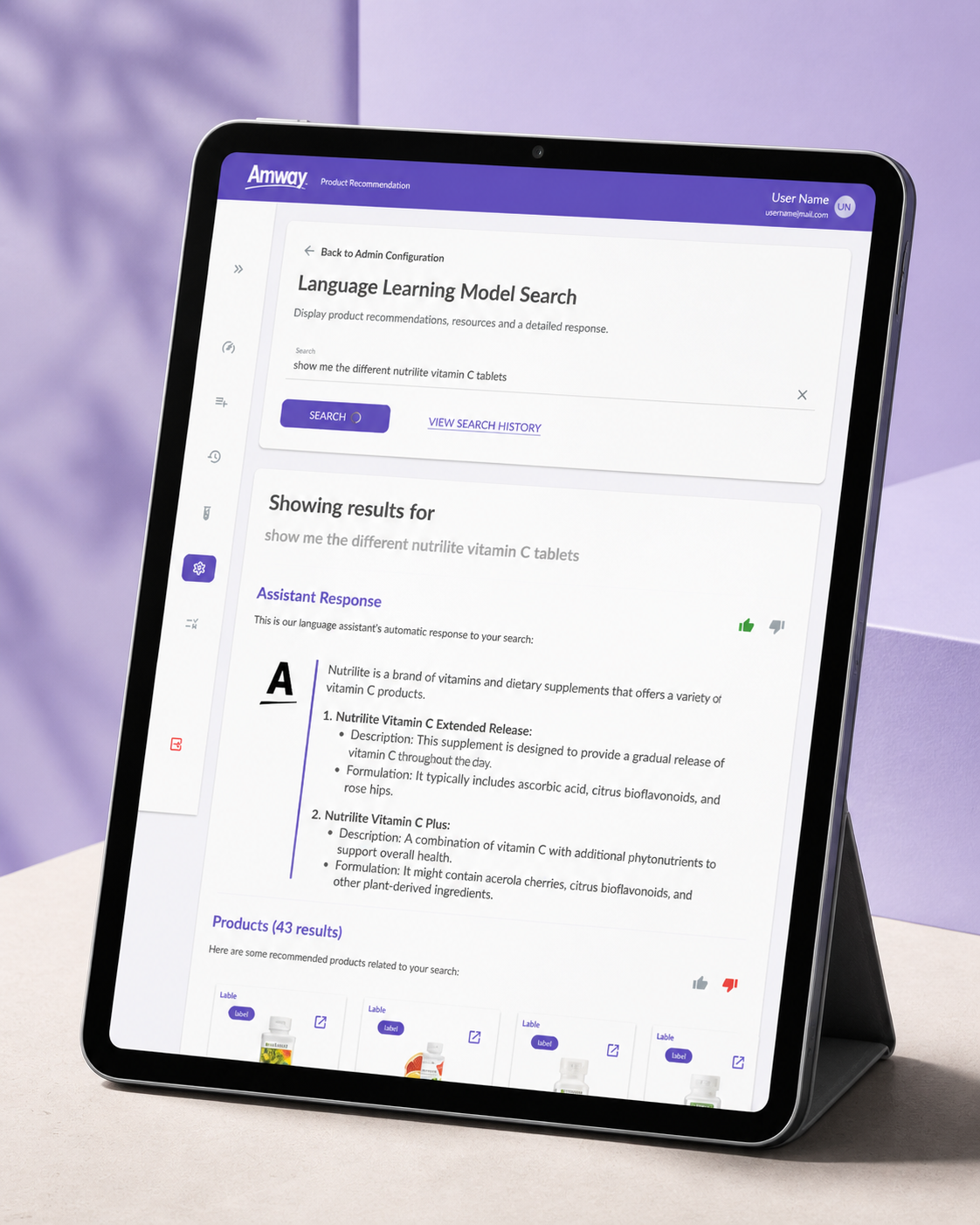
The Amway suite on a tablet — same library, mobile-first composition.
36%
Visitors clicking on a recommended product. The APR’s click-through rate at scale.
24%
Of all items sold on the Amway platform, came through recommendations. Millions in attributable revenue.
$M+
Annual licensing fees saved by replacing the enterprise recommender with the in-house APR.
days 1h
Compliance review time, before and after the rebuilt reviewer.

From a single APR to a six-product suite, done by a small team operating against a shared system, in markets across the world. The work was a milestone. It was also a reminder that the foundation — the system, the documentation, the discipline of choosing the slower path early — is what makes everything that follows possible.